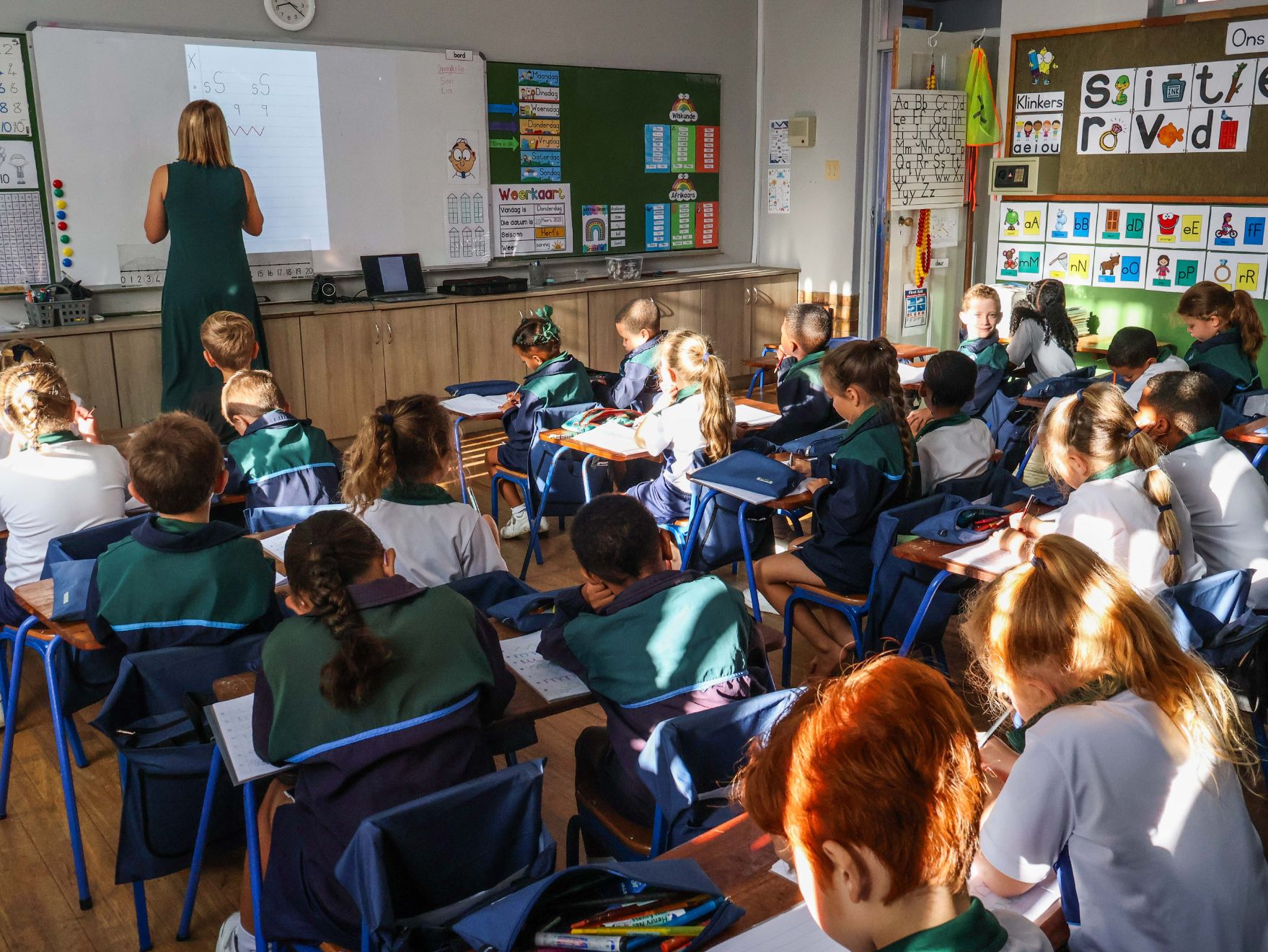
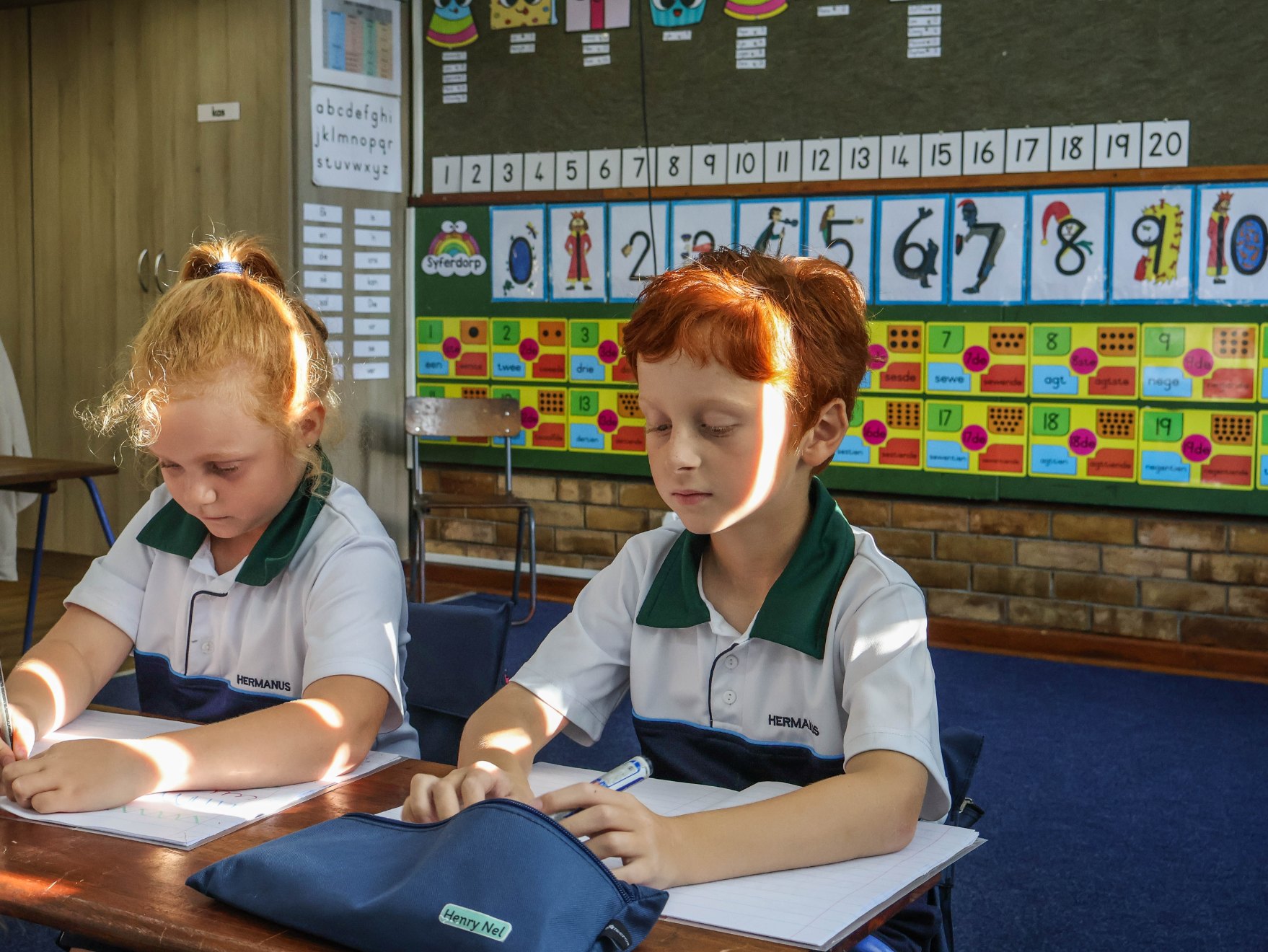
The curriculum forms the foundation of the knowledge, skills, and values essential to learning. We aim to develop our pupils a sensitivity to global requirements.
Objectives
We want to strive for excellence as a phase.
Learners should be relaxed and happy.
Learners must be made aware of good values.
We create space for enrichment as well as support help.
Every learner must have a special place in the full system.
Good communication between educator and the parent should take place on an ongoing basis.
Writing
Grade 1: The letters of the alphabet (lowercase – uppercase); Figures 0 – 100
Writing is finally done in 8.5mm lining
Grade 2: A neat script form is captured
Grade 3: Running script is learned
Subjects In Foundation Phase, 4 subjects are offered:
Afrikaans Home Language
Mathematics
Life Skills
English Additional Language
Afrikaans Home Language
1. An integrated language approach is taken 2. The following skills are developed: – Listen and talk – Readings and Sounds – Handwriting – Write 3. Integration with Life Skills supports language development 4. Supplementary reading books are additionally made available to learners 5. Sounds, Word Building and Dictation are inextricably linked to language development
Additional Language
Grade 1: Language development is supported by listening and speaking skills. Grade 2: Concentrate on speaking, sounding, and reading skills Grade 3: Be Expanded by Reading and Writing Skills
Mathmatics
Mathematics is taught daily. The scope of this subject is summarized in the following five concepts:
– Numbers, operations, and relationships – Patterns, Functions, and Algebra – Space and form – Meeting and data management
The following number ranges serve as a guide for progressives: 1. Grade 1: 0-5-10-15-20 2. Grade 2: 20-34-74-104 3. Grade 3: 74-104-1004
– Activities such as counting, mental arithmetic, and estimation occur daily. – Scrap card activities, arranging, counting on and back, doubling and halving, place value and calculation are developed. – Number concepts (building and analyzing, estimating, counting objects in different intervals, number names and symbols) are rehearsed. – Daily problem-solving activities are offered
Reporting
On the basis of an assessment programme and tasks, feedback is given to parents. Codes 1– 7 for skills are used.
Various mannerisms reported: – Formal reports at the end of each quarter – Parent conversations: a mandatory appointment with each parent at the end of the first term. Conversations by invitation at the end of terms 2 and 3.
General A
message booklet is compiled by the grade group. A message note is pasted in once a week.
Times recommended for homework:
Grade 1 and 2: Approximately 30 minutes per day Grade 3: 45 minutes per day
The Role of the Parent:
Practice tasks, e.g. reading, writing sounds/words
Assisting learners to do capture work
Message note and workbooks must be signed weekly.
Information evening takes place in learners’ classes and the following is discussed:
An Overview of the Academia Covered the Year
Classroom practicals to keep the academy running smoothly.
In conclusion: It is our wish that there will always be good communication between parent and teacher. In this way, educators and learners in the Foundation Phase will be able to GROW together.